Countdown to Husky: the false start and the final plan

Original plans called for widely dispersed landings and the early capture of both Catania
and Palermo. The final plan concentrated Allied forces in the south-east of Sicily (Source: www.canadiansoldiers.com)
Fully-engaged with the effort to defeat Axis forces in Tunisia in the spring of 1943, Allied commanders in North Africa were nevertheless presented with plans for the invasion of Sicily on 11 April.
Operation Husky was the most complex of the war so far for the Allies and involved thousands of hours of staff work and tons of documents. And it had been written in little more than two months.
There were bound to be problems, but the initial response was positive.
“I think we are on a good wicket,” 18th Army Group commander General Harold Alexander wrote in a signal to Chief of the Imperial General Staff General Brooke on 5 April after getting a briefing about Operation Husky code name for the Allied invasion of Sicily.
Invading the island had originally been considered in October 1940 following British successes against the Italian army in North and East Africa. It offered the opportunity quickly to knock Italy out of the war and establish British dominance over the Mediterranean.
But hopes of an early move against Sicily were shattered by Germany’s intervention in North Africa in January 1941 and the quick defeat of both Yugoslavia and Greece. By the end of spring 1941, British, Commonwealth and Imperial forces had been driven back to the Egyptian border and an expeditionary force to Greece evacuated. Crete was captured in May.
The entry of the Soviet Union and the US into the war transformed the strategic balance and the opportunities for Allied advances in the Mediterranean. London secured in principle US support for the invasion of French North West Africa in the first war-time summit between Prime Minister Winston Churchill and President Roosevelt at the end of 1941. This was confirmed at a second Washington summit in June 1942. Anglo-American landings in Algeria and Morocco began on 8 November.

Eisenhower, Tedder, Alexander and Cunningham in Tunis in July 1943
The Casablanca conference in January 1943 was the pivotal moment for Sicily. America and Britain agreed that it should be the next target and its occupation completed by the end of the summer and preferably sooner. General Dwight Eisenhower was appointed Supreme Commander and General Harold Alexander his deputy. Admiral of the Fleet Andrew Cunningham was made naval commander and Air Chief Marshal Tedder the Air Commander. Both were British.
On 12 February, a planning team comprising American and British members began working on Husky under Major-General Charles Henry Gairdner as chief of staff. It was named the Allied Headquarters Force 141 after the number of the hotel room in Algiers that it originally occupied. Force 141 eventually produced eight plans.
Logistics were the predominant issue. American forces were to come mainly from North West Africa and it seemed logical they should land on Sicily’s western tip and take Palermo, seen as vital for supplying the invasion. Nearby airfields were also to be taken quickly. The target for forces under British command, much of it coming from Egypt, was to be the island’s south-eastern tip where the ports of Syracuse and Augusta were also to be seized. Messina was beyond effective Allied air cover and quickly ruled out as an initial objective.
The plan therefore called for two landing forces. The American Western Task Force, headquartered in Rabat, was named Force 343. The Eastern Task Force, which was to be under British command, was designated to invade south-east Sicily. Based in Cairo, it was named Force 545. 8th Army Commander General Montgomery was named commander of the Eastern Task Force and General George Patton the commander of the Western Task Force.
The plan that landed on the desks of Allied commanders in mid-April consequently called for American and British forces to land more than 200 miles apart and separated by Sicily’s challenging landscape. Resistance was expected to be modest. The German Army, seen as being the most formidable opponents, had just over 30,000 troops on the island and there were 30,000 Luftwaffe ground staff due to its importance as an airbase during the war in North Africa.
But the risks were high. Failure to take Sicily quickly would wreck the Allies’ Mediterranean strategy. It would divert resources from preparations for the invasion of France which the Allies had finally agreed would take place in 1944.
The importance of succeeding quickly was spelled out by Alexander in his April message to General Brooke. “Half-measures or half-hearted measures will spell defeat for certain – we must go all out 100 per cent for a win. RN (Royal Navy), RAF and Army.”
It took almost two weeks for Montgomery to respond to the plan and he was characteristically acerbic. In a signal sent to Brooke in London on 24 April, he said the plan was “dog’s breakfast” and would fail. “Unless someone will face up to this problem, there will be a first-class disaster.”
Commander of the 8th Army since the previous August and shaped by his experiences on the Western Front in the First World War, Montgomery was famously cautious. He called for a greater concentration of landing forces in Sicily’s south-east to create an overwhelming force that could punch its way north to Catania and then Messina. His alternative involved eliminating landings at Palermo from the plan and called for the Western Task Force to land near Gela and Licata, less than 100 miles from Eastern Task Force landing beaches.
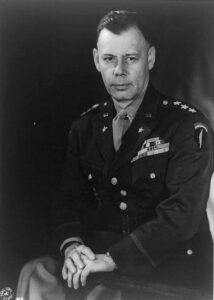 Montgomery flew from the Tunisian front line to the Allied Forces Headquarters (AFHQ) in Algiers on 1 May and presented his idea to Eisenhower’s deputy Walter Bedell-Smith (see right) by breathing on a mirror in a lavatory to write on it. Initially opposed to Montgomery’s revisions, Eisenhower was persuaded of their merits. The final Operation Husky plan was approved after Alexander arrived in Algiers on 3 May.
It entailed landings on 26 beaches initially involving more than 150,000 men and 14, 000 vehicles. Hundreds of landing craft and other amphibious forms of transport would be needed to take the landing force from their ships to the landing beaches. It would be the largest amphibious operation in history, the first Allied operation involving a major airborne element and the most complex combined forces operation ever attempted.
One of the main challenges was ensuring land forces would be properly supplied despite the fact no major Sicilian port was among Husky’s initial targets. The political challenge was mitigating complaints that the US, originally allocated the responsibility of taking Sicily’s capital, had been consigned to a minor supporting role to the British.
How these challenges would be addressed will be dealt with in future articles.