The Breakout from the Santerno bridgehead – 13 April 1945
Despite the lack of coherent enemy activity in this area, it was thought that Conselice would be a tougher nut to crack. Just to the west of the town lay the last bridge over the Molini canal before this waterway joined the Reno river five miles further north. For all the enemy troops south of the Reno and still east of the canal, this was the last way out to the west. How many enemy there were in this pocket, it was hard to estimate, but it was certain that he would keep his way out open until the last possible moment.
This thought in mind, 6 RWK set out from San Patrizio in the lifting darkness at 0520 hours – the battalion was supported by a squadron of 48 Royal Tanks. An hour later, two companies were 500 yards short of Conselice and encountering bitter opposition. One troop of the tanks succeeded in knocking out two enemy self propelled guns but, itself, sustained a casualty, the troop leader being killed and his tank receiving a direct hit on the turret. The encounter was at close range; immediately the enemy saw his success, a small party dashed forward and boarded the tank. A moment later, it was driven away complete with the remainder of its crew, if these survived and carrying code documents and equipment. It was found later, abandoned north of the village.
As always in his rearguard actions, the enemy made great and effective use of his self propelled guns. Throughout the morning of the 13th, scattered pockets of infantry, fighting with the support of these guns, engaged our own forces in a fierce struggle for the approaches to the town. Some 20 or more prisoners were taken but no decision was reached in the fighting and it was impossible to push on. At 0945 hours, the Air Force had been called upon and engaged, with gratifying effect, some guns in the eastern outskirts of the town. The nut, however, remained uncracked.
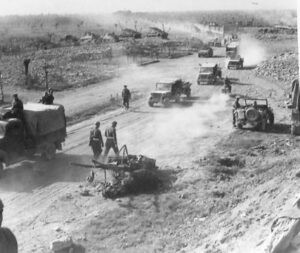
(NA 24038) Original wartime caption: A never-ending stream of supply vehicles pour across the river Santerno.
Turning now to the Irish Brigade’s sector, the main axis of advance for the Division, the fight had begun in earnest. In the early hours of the 13th, the brigade launched its long planned attack with two battalions up; on the right 2 Innisks., on the left 1 RIrF. Each battalion was supported by a squadron of the Queen’s Bays (Sherman Tanks) and a troop of ‘Crocodiles’ (Flame throwing Churchills) from C Squadron, 51 Royal Tanks. In addition, engineer assault equipment was available to assist the movement of the armour.
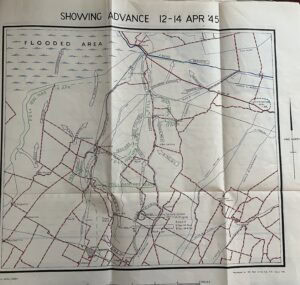
The start line running west from the San Lorenzo was bounded on the right by the river Santerno, with its high floodbank and, on the left, by the Fossatone canal. The plan was as follows. The two infantry battalions, each with its armoured squadron, were to force a passage northwards between the two waterways as far as the Scolo di Conselice, which crossed the line of advance some 7,500 yards to the north. Having reached this point which was, in fact, almost at the apex of a narrow triangle, whose base was the start line, the bridge giving access northwards was to be seized and the ‘Kangaroo Force’ passed through. It was a straight forward plan, bold and simple and in perfect unison with the higher plan to strike swiftly at the pivot of the enemy’s defence, Argenta.
The initial frontage of the attack was little over 2,000 yards and both battalions were engaged in stubborn fighting, pushing the enemy back in a slow drive lasting two and a half hours. By mid morning, approximately half the distance to the Conselice Canal had been covered and the frontage between the two waterways had shrunk to 1,000 yards. Numerous enemy strong points were encountered and these appeared to be getting harder to overcome as the front narrowed.
With the Inniskillings just short of San Bernardino and engaged in liquidating a very troublesome enemy post on the riverside, the Irish Fusiliers were directed westwards and crossed the Fossatone canal shortly before 1100 hours. The advance was then continued on a broader front as the Innsikillings approached closer to San Bernardino and the Fusiliers came up level with them on the left.
The village itself proved troublesome. 8th Indian Division attacked it on the east of the Santerno and the Inniskillings fought for the western portion but the enemy’s 362nd Infantry Division, although tired, disorganised and short of everything it required, was putting up a stout defence. The village was finally overrun, both to the east and the west of the river and it was reported clear at 1300 hours.
By this time, the leading troops of the two Irish battalions had made further progress on the left and reached the village of La Giovecca. This was occupied by 2 Innisks and theroad thence to the east was cleared for a short distance. 1 RIrF was level with their sister battalion on the left of the Fossatone canal and was facing west to protect a flank which had, by now, become exposed as 36 Brigade fought for Conselice. On the right, east of the Santerno, A Squadron of the Recce Regiment pressed northwards in conformity with the Irish Brigade, under whose command it had been placed at 0730 hours that morning.
While these events were taking place, many moves had been made further back in preparation for the future. 5 Buffs and 56 Recce Regiment, less A Squadron, had been moved up to join 36 Brigade in the area of San Patrizio, the Regiment passing to under command of this Brigade on its arrival at approximately 1120 hours. At the same time, 11 Brigade was being moved up from the back areas, where it had been held since the first assault and was concentrating in the area of Lugo.
To return to the Irish Brigade, however, at 1300 hours, the Innskillings and Royal Irish Fusiliers, although they had reached the apex of their triangle, were ordered to consolidate positions in preparation for the ‘Kangaroo Force’ to pass through.
Soon afterwards, this move began. Under command of 2 Armoured Brigade, the force of armour and infantry, composed of 9 Lancers and 2 London Irish Rifles in the ‘Kangaroo’ carriers of A Squadron of 4 Hussars debouched from their positions held by the Inniskillings and advanced towards the bridge at Cavamento, the apex of the original triangle. The ponderous mass of vehicles took some time to manoeuvre through La Giovecca and the afternoon was drawing on before the force was in full cry.
Resistance at first was patchy and undecided. Here and there, parties of enemy with Bazookas caused trouble and one tank was lost by fire from an anti tank gun early in the battle. On the whole, however, it appeared that the enemy was shaken; his grip everywhere was loosening.
By mid afternoon, the leading elements of the force were approaching the canal. The right flank was no longer limited by the Santerno river and this gave more room for manoeuvre. H Company came up on the left of G Company, together with C Squadron 9 Lancers.
Determined resistance was met in the village of La Giovecca just before the canal but G Company dealt with this and H Company was able to drive straight through in its Kangaroos. Reaching the canal bank, the leading tanks were dismounted at once from their Kangaroos and, under cover of fire from their supporting tanks, crossed the canal on the remains of the road and railway bridges and rushed the bridges on the north side. More prisoners were taken and a surprised and shaken enemy was hunted down in areas, which had been by-passed by the swift thrust.
H Company was ordered to hold the bridgehead over the canal with assistance from E Company, which was also engaged in clearing La Frascata. G Company was clearing the area up to the canal bank on the right.
At 1830 hours, 2 Armoured Brigade reported two troops of 9 Lancers across the canal where the bridge, although badly damaged, had not been utterly destroyed and was just passable for tracks. Mopping up and consolidation was in progress and the Engineers were at work making a new road bridge under cover of the infantry and tanks.
On the left, 36 Brigade was still engaged in stiff fighting. Little material progress had been made in Conselice during the day, where the enemy was firmly ensconced. As a result of the rapid advance of the Irish Brigade on the right, a gap had appeared in the Division’s front between the two brigades, 6 RWK were fully deployed in the area of Conselice and one company of the 5th Buffs was, therefore, brought up to fill the gap. This was complete by 1630 hours.
At about this time, the enemy mounted a strong counter attack upon 6 RWK from out of Conselice and fierce fighting raged for an hour or more. The headquarter buildings of two forward platoons were hit by enemy shells and set on fire but the attack was eventually beaten off just before sundown.
The general indications on this left flank seemed to show the enemy was determined to hold his ground: a firmness of intention in his defence was apparent for the first time. It was therefore decided that a coordinated attack by the whole Brigade would be necessary and the remainder of 5 Buffs was ordered to move to San Patrizio at once.
As final light fell, there was a temporary halt on the whole of the Divisional front; the day’s gains were being consolidated on the right, whilst 36 Brigade prepared to clear up Conselice and the surrounding area on the left by a deliberate attack.
The plan of the 36th Brigade Commander was to push north-westwards to cut the road from Conselice to Chiesanova and, subsequently, to clear the town of Conselice itself. To this end, the Argylls were to attack in a preliminary operation and clear the area to the south west of Conselice; 5 Buffs were then to pass through and cut the Conselice – Chiesanova road; finally, at first light, 6 RWK were to clear the town.
By 2245 hours, the Argylls reached their objectives with little difficulty, taking seven prisoners and losing only one man wounded. The Buffs passed through at once and met no opposition to their thrust across the road. At the same time, information was received from civilians that the enemy had departed from the town, although he had probably not gone far back. 5 Buffs was ordered to push onto Chiesanova and 6 RWK was to confirm that Conselice was clear.