The breaking of the Argenta Gap – 15 April 1945
The focal point of interest was now the narrow strip of land known as the Argenta Gap. Its tactical importance can be seen from a glance at the map. Briefly, it was as follows:
The enemy’s defence south of the Po ran from the coast into the mountains, south of Bologna. Initially, they had been secured on his left by the Comacchio Lake, but the operations of the 56th Division and 2 Commando Brigade had forced him to pull back in this sector and his line was thus cut adrift at one end. The advance from the Senio and across the Santerno had caused the wholesale withdrawal of his front and, in order to stave off a major and strategic disaster, it was essential for him to find a firm pivot on which his whole line In the eastern sector of the plain could turn. This was the most urgent at this time, as the forces of the Polish Corps, south of Bologna and of the Fifth Army further to the west, were loosening his hold on the mountains. Even if the whole front around Bologna should start to crumble, as indeed he felt it might, he still required that firmness between the mountains and the Adriatic so that an escape route might be kept open.
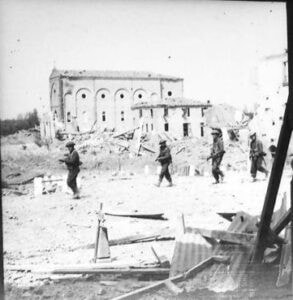
(NA 24058) Original wartime caption: British infantrymen advancing through the bombed and shelled ruins of Filo.
The main threat of the Eighth Army from the opening of the offensive onwards was directed on Ferrara and the crossings of the Po to the north of this town. Once these were lost, there was great likelihood that all the enemy forces in the plain south of the river would be lost. Where, then, was he to halt our thrust on Ferrara?
The threat was developing from the south east. Route 16, or subsidiary roads in alignment with it, was the likely axis and, on this line, an ideal piece of country had been selected for defensive works. To the east was flooded land stretching away to the northern part of the Comacchio Lake, with no main roads and few minor ones that were passable for heavy traffic. To the south west, a further tract of flooded waste stretched almost to Bologna. The natural obstacles in both areas had been increased by artificial flooding and demolitions. All this had been done by the enemy months before, causing no inconvenience to his lines of communication and requiring little labour.
The stretch of land, which remained, was between two and three miles wide and four miles in depth: a narrow funnel between the marshes. Careful thought was put into the organisation of defences for this strip of land, the Argenta Gap. Mines were laid thickly and in depth: houses were fortified, every bridge was prepared for demolition: an extensive network of trenches and wire linked together the native dykes, canals and ditches, to make a corrugated passageway incapable of being rushed by tanks or infantry.
Given the men to occupy the defences and the time to get them there, the enemy was confident that the block would hold and, in the worst possible case, a temporary halt would be achieved before we could turn his flanks with a ponderous semi amphibious plunge on either side.
His appreciation was a fair one; the position was strong: there was only one “but”, could he organise his forces in time? On the evening of April 14th, the matter was about to be put to the test.
It had been evident to the Corps Commander earlier in the day that to wait for a bridge to be built over the Reno, before 78th Division could add its weight to that of the 56th in assaulting the gap, would create a danger of losing the speed and momentum, which was so vital. Accordingly, orders had been issued for one brigade of the 78th Division to move at once through Alfonsine to the north side of the Reno and take over the left sector of the 56th Division’s front.
Later in the evening, 11 Brigade moved north. That night, it concentrated north west of Alfonsine with one battalion over the Reno.
In order further to liberate the Division in the sector between Bastia and the New Zealand Division’s right flank, 2 Commando Brigade was placed under command and began to take over the commitments of 36 Brigade, which was still on the left flank.
In the Irish Brigade’s sector, there was little activity, save for patrolling and an historic event, when the 1st and 2nd Battalions of the London Irish Rifles met, side by side, for the first time on a common battleground. This was occasioned by the approach of 167 Brigade on the north bank of the Reno, with the 1st Battalion leading on the left.
The 15th and 16th were days of vast activity in regrouping and movement. 11 Brigade was moving through 167 Brigade in the area north of the Reno, remote from the rest of the Division by reason of the lack of a bridge. 167 Brigade, less two battalions, came under temporary command of 78th Division on the 15th and reverted to command of the 56th Division the next morning. 2 Commando Brigade completed the relief of 36 Brigade but remained under command of 78th Division. The Recce Regiment passed to under direct command of 5 Corps and returned again to the Division’s command soon afterwards.